
November 2026. We responded to the Scottish Government consultation on proposed legislation to restrict the use of mobile phones in schools.
1. The Scottish Government has committed to restricting the use of mobile phones in schools. To what extent do you agree with the following options?
We have previously expressed our support for the Scottish Government non-statutory guidance on mobile phones in classroom, published in August 2024. This provided both schools and individual teachers with the ability to restrict the use of mobile phones in situations where they interfere with learning, but also the flexibility to use mobile phones as a part of active involvement in learning. This is particularly important in schools where pupils do not have access to their own laptop or tablet.
Our view is that legislation to restrict the use of mobile phones in schools is not required, guidance can achieve the same result and be updated as necessitated by changes in technology and usage.
Where restrictions are in place, there will be less interference with children’s rights if these are not in place across the whole school day.
Human rights framework
Any decision to restrict the use of mobile phones in schools must draw on a careful consideration of the impact it will have on the full range of children’s rights under the UNCRC. All rights contained within the UNCRC apply equally and any interference with them must meet the test of being necessary, proportionate and time limited.
Our view is that whilst it may be proportionate for children’s access to mobile phones to be limited during lessons, restricting use before and after school and during breaks has the potential to create more significant impacts on children’s rights and require many more exceptions to mitigate these.
It is simplistic to think of mobile phone use in schools simply as accessing social media, watching videos or messaging. Modern mobile phones are rich devices with a wide range of uses, educational or recreational, and for the current generation of children and young people have been around their entire lives. They come with risks but also benefits and will form an important part of children’s adult lives, including their working lives. States have a duty to prepare children for a digital world, and part of that duty is to support them to manage their use of mobile phones responsibly and to keep themselves safe online. The concept of evolving capacities is an important consideration, restrictions which may be proportionate for a younger child may not be for an older child.
The UN Committee on the Rights of the Child has stated that “the concept of the child’s best interests is aimed at ensuring both the full and effective enjoyment of all the rights recognised in the Convention and the holistic development of the child”.[1] It is important that children’s rights are not hindered by negative interpretations of what is in their best interests. Any interference with their rights on the grounds of risk of harm, for example, needs to be proportionate and alternatives must be carefully considered.
Children’s use of mobile phones during school time engages a range of the rights contained within the UNCRC. If we use the example of restricting phones to decrease distractions during lessons, interference can be justified by a positive impact on other rights, such as ensuring all children’s right to an education (Articles 28 and 29 of the UNCRC) is realised.
In other situations, the balance is less clear. Removing the ability of children to listen to music to relax at lunch time (Article 31), preventing them accessing information about services (Article 13), or prohibiting having a private way to contact their parents (Article 16) must be underpinned by evidence that it is proportionate as a means of protecting other rights, taking into account the purpose of the ban.
Likewise, prohibiting phones being used for educational purposes may, in the absence of school provided devices, result in children not developing the digital skills that form an essential part of a 21st century education.
Restrictions interfere with rights; they must be evidenced as necessary and proportionate.
Purpose of ban
“Mobile phones are a part of society and can be used as a learning tool. It feels as if the people making these rules don’t understand that. I would love to see more education about social media and discussions about why/how to reduce phone use without eliminating it completely” – girl, 16, South Australian research[2]
It is important to be clear what the intended purpose of any restrictions are to enable an assessment of its necessity and proportionality, in human rights terms. If the intended purpose is not clear it will also be difficult to assess the effectiveness of these restrictions.
Yet the consultation paper provides no clarity on what the intention of these restrictions is. There is very little detail and no supporting evidence presented in what is a very brief consultation paper.
Despite explicitly excluding the use of mobile phones outside school campuses and the use of social media at home[3] both are addressed within the background to the proposed restrictions. Concerns raised include those not limited to the school day, including issues with sleep, seeing harmful, often violent, misogynistic or radicalising content, incitement to self-harm and grooming.[4]
Restricting phones in schools will do little, if anything, to address these issues. Children’s time in school represents a small proportion of their lives. Reducing the amount of time a child can use a mobile phone at school will not necessarily reduce their level of risk. Indeed, it may increase their vulnerability by reducing their confidence to seek help for online issues through school.
In response to the UK Government consultation on restricting access to social media, we produced a Children’s Rights Impact Assessment (CRIA) exploring the human rights impacts of the proposed restrictions.[5] Many of the same rights are engaged by restrictions to mobile phones in schools.
Online harms can only be addressed through a societal response which includes regulation of service providers and, perhaps more importantly, supports children, young people and their parents by giving them the knowledge and skills to keep themselves safe in the modern world.
The UN Committee on the Rights of the Child has made it clear that states have a specific obligation to:
“facilitate educational programmes for children, parents and caregivers, the general public and policymakers to enhance their knowledge of children’s rights in relation to the opportunities and risks associated with digital products and services. Such programmes should include information on how children can benefit from digital products and services and develop their digital literacy and skills, how to protect children’s privacy and prevent victimization and how to recognize a child who is a victim of harm perpetrated online or offline and respond appropriately. Such programmes should be informed by research and consultations with children, parents and caregivers.”[6]
Primary Schools
Our response, like much of the discourse around mobile phones in schools and almost all the international research, focusses on the impact the proposed restrictions will have on children and young people at secondary schools.
Increasingly children in primary schools do have their own mobile and some bring them to school, but ownership of mobile phones rises steeply from age 11 as children move to secondary school.[7] Where they are travelling to or from school independently, this can support a level of independence while enabling them to contact their parents in an emergency. The use of mobile phones for education purposes is less prevalent in primary schools and breaks have more opportunities for supported play or activities than in secondary schools. Our view is that non-statutory guidance offers schools the ability to appropriately manage the use of mobile phones in primary schools.
Full day vs class time.
Much of the research evidence on the efficacy and impact of mobile phone, restrictions does not differentiate clearly between strict bell-to-bell bans, with or without exceptions, and restrictions only during class time. In most cases, studies involved schools which operated with a degree of autonomy and it was not clear whether or not teachers were able to permit mobile phone use for educational use.[8]
Cost of phone bans
We are concerned that implementing phone bans may have a financial cost, to schools or to families, as well as requiring significant staff resource. We are not convinced that expenditure on systems or equipment, such as pouches and lockers, is a proportionate use of scarce education resources.
In Edinburgh, provision of lockable pouches for all secondary schools was agreed at a cost of £400,000 in set up costs and up to £100,000 a year of ongoing costs. No estimate of staff time was made.[9]
Taking a health economics approach, Perry et al examined the costs of implementing mobile phone restricts in a nationally representative sample of 20 schools in the English midlands, including the costs to staff time. They found that for an average school size of around 1000 pupils, implementing a mobile phone ban took between 3.1 (for the most restrictive bans) and 3.3 (for permissive policies) full time equivalent staff.[10] This is a significant and expensive cost which would mostly be borne by schools.
Banning from school premises
We would oppose any suggestion that children and young people, of any age, be prohibited from having a mobile phone with them as they travel to and from school. They contribute to ensuring that children are able to travel safely and reduce, for example, risks where normal transport is delayed or interrupted, where children are travelling to after-school activities, collecting siblings on their way home or returning home alone. Given the lack of suitable childcare for older children (particularly for children in the early years of secondary) a mobile phone may be a parental choice to ensure their child is safe before and after school.
2. What is your knowledge of how phones are being used in schools at the moment?
Since the pandemic, the topic of phone use at school is one which we have often discussed with children and young people, across many different schools. To inform this response, we discussed the Government’s proposals with our current group of young advisors via the online platform we use to communicate with them.
Young Advisors’ views
We asked our young advisors what they used their phone for at school. Some came from schools where bans were already in place, one where a ban had ended and some with no bans. Not all of the group have a mobile phone.
“Socialising, checking in with parents, revision, having something to if alone (play games, listen to music, watch something, etc), timetable, rechecking teams (school app).” – CYPCS young advisor, asked what they use their phone for.
“It’s very important for my music education as I take exams that are at a higher level than my year. I use it for google classroom, online things like metronome and contacting my parents. pls don’t ban it!” – CYPCS young advisor
“Nothing, I don’t think people, unless there are certain circumstances, need their phones” – CYPCS young advisor
Some supported the ban, others did not. Many responded that they would use a laptop or computer to do online tasks they currently use a phone for (though we note below that not all children have access to a school-provided device).
Others were opposed to the ban, highlighting both educational and non-educational uses of their phone during the school days. Although these included socialising, finding their friends during breaks, listening to music and checking in with parents, we also heard of important educational uses including using apps to support music lessons, for revision and study planning and using their mobile phone to access Teams (used for homework and lesson information).
In assessing the impact of restrictions on mobile phone use, and in particular the difference between full day or lessons-only restrictions, it is important to assess the wide range of things children use mobile phones for in school. Much of the debate focusses on negatives, particularly the use of social media and cyberbullying. But children tell us that there are also many positive uses for mobile phones during the school day, both in class and during breaks.
There is limited research involving children and young people’s views on and experiences of restrictions on mobile phone use during the school day.
Research in South Australia, conducted at the time a state-wide ban was being introduced on a staged basis, found a similar mix of views. Children identified a mix of positive and negative impacts and at times they disagreed with each other. Some children felt that the ban undermined efforts by their schools to build digital skills, self-directed learning and independence. However, they also identified that bans, for the most part, had resulted in fewer distractions in class time and improved listening.[11]
Access during lessons
In the classroom, the negative impacts of a ban can be mitigated through empowering teachers to use their professional judgement to permit phones to be used for educational purposes. There are many such uses and they are particularly important in schools where children and young people are not supplied with a laptop or tablet by the school. The UN Committee on the Rights of the Child, in their General Comment 25 on children’s rights in the digital environment, highlighted digital literacy as an important element of education and that “curricula should include the knowledge and skills to safely handle a wide range of digital tools and resources”[12]
- In language classes, phones can be used to look up words and phrases and unlike a traditional dictionary can provide pronunciation and usage examples
- Activities like Kahoot, Quizlet and mentimeter can add interactive content to lessons and increase engagement and also enhance assessment.[13]
- Developing children and young people’s online research skills, including their ability to engage critically with various sources of information. In the absence of school-provided devices, or when those devices aren’t working, students can use their mobile phones to develop digital skills.
An evidence review on behalf of the Scottish Government’s Online Safety Taskforce found evidence that purpose of digital engagement is an important factor in any association between digital media use and mental health and wellbeing, with digital media use for school work associated with fewer adverse outcomes.[14]
Access to information, support and services via QR codes
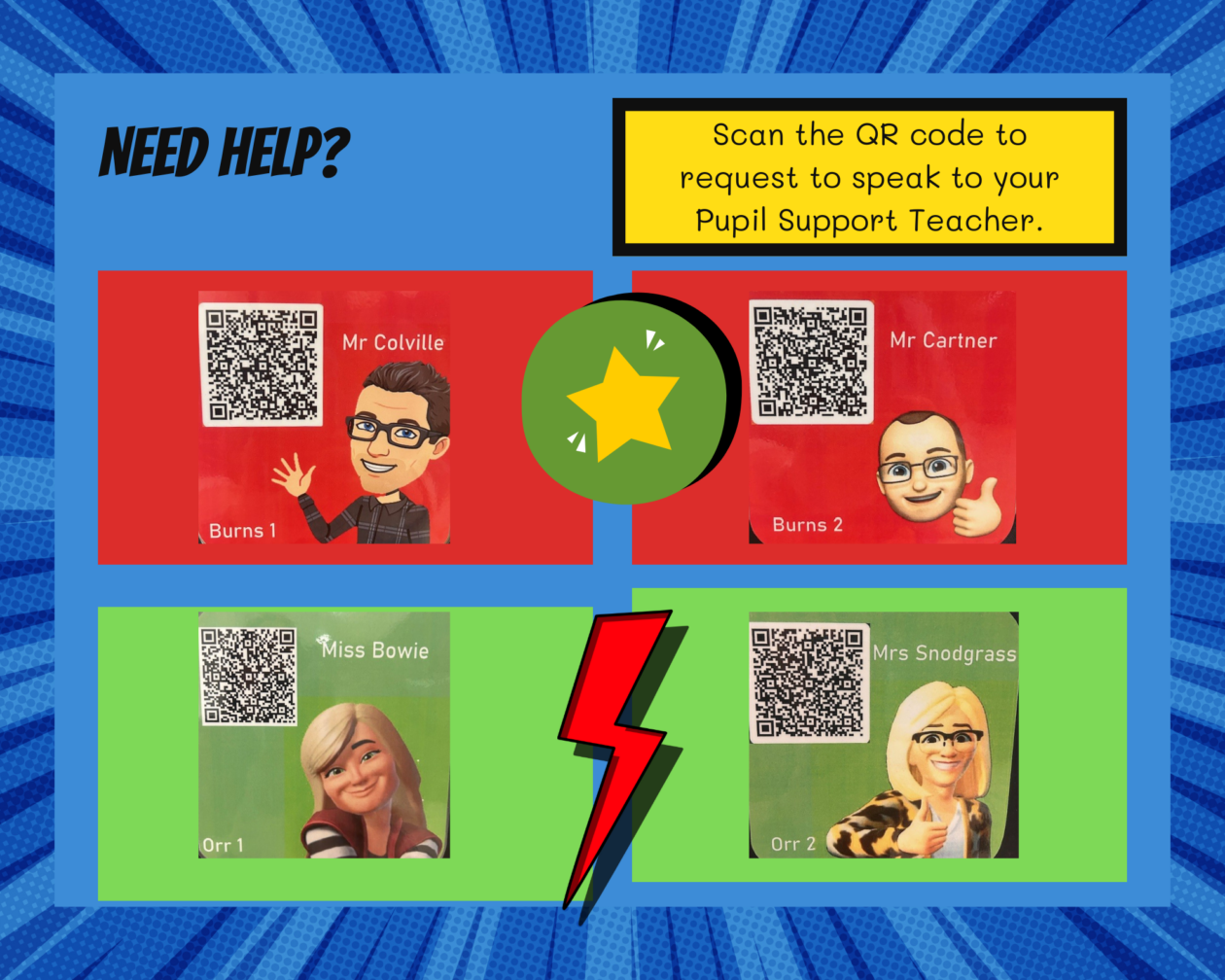
Children and young people have told us of positive experiences in schools where access to in-school counselling is via a QR code and online form. Again, this allows children to self-refer directly to the counsellor. Children have told us that this has significant benefits to systems where they are required to access counselling via a guidance teacher or the school office, which makes them anxious and may draw attention to their requests.
We’ve also heard of examples that use QR codes as a way of anonymously or discreetly reporting incidents of bullying in school. Using their personal device, they can quickly scan a QR code and then access a form in privacy. Respect Me have highlighted this as good practice.[15]
In both examples, offline referral processes could replace QR codes. However, children have identified this to us as an area of good practice that widens access. Access to mobile phones out of class time would allow children to complete online forms and request support in privacy.
Other services also use QR codes on posters as a way for children and young people to access information, advice and services.[16] They are also used in educational materials to provide access to further information. Replacements to this way of working would require accessible printed materials.
For some children at risk of harm in the home, for example due to domestic abuse, neglect or other abuse, using their mobile phone while out of the home may be their only opportunity to access information or support. School can be a safe space for these children. Children in this situations may not want to draw attention to themselves by requesting an exception or approaching a member of staff.
During breaks
In Scotland, it is not unusual for children to leave the school premises during lunchtime. This is particularly the case in secondary schools and in some cases is necessary where school dining halls lack the space for all children to eat their lunch. Less commonly, some children in primary school return home for lunch.
Lunch breaks, therefore, do not form part of the compulsory school day and could be considered children’s own personal time. Where a child is leaving the school premises, having their mobile phones with them enables them to communicate with parents, access information and use contactless mobile payments.
Children’s right to relax and play during the school day can be supported by their mobile phones. Children tell us they use phones for a wide range of things, including listening to music, watching videos and reading. Secondary aged children tell us there is often little to do at lunchtime, other than “hang around”. Access to sports activities, school libraries and other facilities is often limited and even where activities are available there are not enough places for all pupils. Common areas in schools can be noisy, crowded and stressful environments.
“To message my mum and listen to music, which helps with stress as lunch and break time is very noisy and filled with bullies”. – CYPCSyoung advisor
For some children, their mobile phone can be a useful tool to help them relax and self-regulate. They may access a mindfulness app, for example one of those recommended by NHS Lothian’s Child and Adolescent Mental Health Services[17] or the City of Edinburgh Council[18], or just by listening to music.
3. Think about the different things young people might use their phone for in school. If restrictions on mobile phones in schools were introduced, what do you think the positive impacts might be?
Distractions
Phones causing a distraction in class is the strongest argument for restricting their use, although our position remains that this can already be achieved with the current guidance. This would also allow schools and teachers flexibility to permit use of phones where, for example, there was an educational reason to do so.
A meta-analysis of existing research, conducted in 2024, found that there was evidence that “a ban on smartphones can lead to a calmer and more focussed learning environment”, with teachers reporting a reduction in distraction. Böttger and Zierer also emphasise that rules in schools are most effective when decisions about how to implement include staff (and we would argue pupils) and that a ban on smart phones should not preclude their use for educational purposes. [19]
Children and young people participating in the South Australian research acknowledged that mobile phones were a cause of distraction. They reported improved listening, focus and engagement. However, some argued that bans meant that they missed out on learning how to manage that distraction.
“It doesn’t prepare us for the real world when we will have to deal with these distractions in our life” – girl, 16, South Australian research[20]
In a review of a mobile phone ban in Sweden, where the national policy allows teachers to permit use of mobile phones for educational purposes, teachers reported that other distractions increased, particularly the use of school-provided laptops.
We have also heard of instances where restrictions on phones increased tensions in school and caused a distraction.
“Phone policy did cause huge tension within my school because it led to arguments with argumentative pupils and teachers and sometimes take away from learning” – CYPCS young advisor.
The OECD’s PISA research did find that mobile phones were a significant cause of distraction in schools and they were supportive of “clear policies on mobile phone use – whether through bans or well-defined guidelines” includingsubject-specific guidelines.[21]
Attainment
Research on the effect of mobile phone restrictions on attainment is mixed.
Campbell et al’s review found mixed evidence regarding the impact of phone bans on attainment. In some cases this may be because in some schools, children were in fact using their phones for educational purposes. Two largescale studies (in Norway and Sweden) found no differences in academic achievement. They concluded that there was “a lack of studies able to demonstrate cause and effect” in support of mobile phone bans. Since many studies equate strict bell-to-bell bans and more flexible restrictions, including those which permit use for educational purposes, the impact bans had on attainment is unclear[22]. Likewise Böttger and Zierer found limited evidence of an impact on academic attainment.[23]
PISA notes that its data does not allow for any “causal inference” to be made between changes in attainment (higher or, in the case of science, lower average attainment) and an increase in the prevalence of mobile phone restrictions in schools.[24]
Online bullying and mental wellbeing.
The consultation paper suggests that banning mobile phones may help address increases in a range of serious behaviours in schools, including bullying. Yet, the Scottish Government’s own guidance Respect for All: The National Approach to Anti-Bullying for Scotland’s Children and Young People states that “online bullying should be seen as related to where bullying occurs, rather than as a different behaviour type; many common bullying behaviours such as spreading rumours, exclusions from group dynamics and threats can occur both online and offline”.[25] The guidance acknowledges that technology has increased the complexity of bullying, but notes that significantly more children experience bullying at school than online.[26]
One school in Scotland visited recently by the Commissioner heard from some children that fights had increased during playtimes since the mobile phone ban at their school had been introduced. Much of the evidence in Scotland related to the impact of mobile phone restrictions remains anecdotal.
Respect Me are clear that it is unhelpful to think of online and in person bullying as separate behaviours – the online world is just another place children and young people go, to meet virtually with friends and socialise.[27] Often these are children who know each other through school. Most international research has concentrated on the effect of mobile phone bans specifically on cyberbullying, there is only limited evidence that they can reduce bullying overall. Restricting the use of mobile phones in school will address only one aspect of bullying and may result in the bullying simply moving location – from online to in person or from during the school day to outside it. In South Australia, researchers found mixed views amongst children and young people. Whilst some reported a reduction in bullying, particularly cyberbullying, one reported bullying had worsened “If anything the ban has made everything worse. A lot do follow it and problems like vaping and bullying happen more as people find a way to make up for their boredom [F, 13]” and that for some children, loneliness and isolation increased “If you don’t have friends at school, you just have to sit there and be alone without talking to anyone [M, 16]”.[28]
Campbell et al also found conflicting evidence, with a number of studies finding a decrease in bullying following mobile phone bans, but two finding an increase in online victimisation. The 22 relevant studies they analysed provided inconclusive evidence of mobile phones impact on mental wellbeing. They suggested this may be linked to other aspects of school cultures.[29] Likewise, Perry et all noted that their own research had found that restrictive smart phone use in schools was not associated with benefits to adolescent mental health and wellbeing.[30]
In our CRIA on the UK government’s proposed ban on social media, we raised concerns that children may be less likely to seek support for online harms if their access to social media was restricted. We have the same concerns about strict bans on mobile phones in school.
4. Thinking again about the different things young people might use their phone for in school, if restrictions on mobile phones in schools were introduced, what do you think the negative impacts might be?
Online learning platforms and educational apps
During the Covid pandemic, schools developed their use of online platforms, including Teams and Google classroom, to support children’s learning. Many continue to use these for access to materials, homework allocation and sharing information between home and school. Children and young people in schools where all pupils have access to a school supplied digital device will continue to benefit from these. In schools where this is not available, it is an example of why allowing teachers to use their professional judgement to permit the use of mobile phones during class time for educational purposes, should be retained.
There are a wide range of education apps available that support children’s learning. This includes basic apps such as calculators and timers that could be replaced with an analogue equivalent, but other apps give functionality that would incur additional cost or not be accessible without a mobile phone.
“I … use a metronome and tuner to practice for my music exams…” – CYPCS young advisor.
Cameras can be used to capture notes on a blackboard or record results from a chemistry or biology lab, in video or still format. In subjects like art and design, pupils can build a record of project work as it develops.[31] Light meter apps can mean those starting out in photography have access to a basic light meter in their pocket.
Punitive consequences for use of mobile phones
Where restrictions are introduced, particularly those with statutory footing, much more consideration must be given to proportionate enforcement. It is unclear how these restrictions would be enforced and what the consequences of violation may be for children. Could we see an anxious child, who has kept their phone in their bag for comfort, removed from a classroom? Sent home from school? Might devices, which are personal property, be confiscated for recovery by parents?
What is the appropriate consequence in the view of Scottish Government?
Meaningful evaluation of the impact of statutory restrictions should form part of the legislation. Consideration should be given to the financial and administrative impacts of administering the restrictions and capture any unintended consequences.
5. If restrictions on mobile phones in schools were introduced, there would be exceptions to allow certain children and young people to use their phones if they have an important need to do so. This would mean those children and young people would have access to their phones only for the purpose of using them for their specific need.
Mobile phones are a normal part of modern society and have been part of children’s lives since they were young. During the pandemic, they were an important way for children to keep in touch with both their friends and schools.
For many children, phones can be an important tool to navigate a complicated life. For some, such as young carers or children with a parent serving in the armed forces, contact with parents and family may be particularly important. For those with medical conditions, such as diabetes, they can be used to monitor health needs through the day. And for those who find attending school difficult, it can be an important source of support.
Exceptions are an important way of removing barriers to children attending school and without them some children may opt not to attend school in some situations. There must be a clear exceptions policy in place before any restrictions are implemented.
We have previously asked the government to ensure that exceptions to any guidance or legislation restricting mobile phone use is drawn widely enough to ensure that children who have a good reason for access to a mobile phone can do so, at all schools. Any requirement for evidence should be managed respectfully and not place extra burden on children and parents. Flexibility and discretion for schools should be aimed at covering additional exceptions, not narrowing them. Some children may require temporary and urgent exceptions, such as a parent being taken into hospital, onerous exceptions processes would disadvantage them.
For many children, access to a mobile phone during lunch and breaks may be sufficient. Restrictions that only cover lessons would not affect them and exceptions would not need to be provided.
It is inevitable that a restriction lasting throughout the school day will require more exceptions to ensure its interference with children’s rights is proportionate.
The following are some of the circumstances we have heard, from children and young people, their parents, or others, where an exception would be justified:
Young carers may need access to be able to respond to urgent messages from home. Where they are responsible for caring for siblings before or after school, not being contactable could create a safety issue for their siblings. For children with a close family member in hospital, severely ill or in palliative care, knowing they are contactable can support attendance and participation in school.
Children who use medical devices such as insulin pumps, need access to their mobile phones during class time and breaks. This is a widely recognised need and schools should not require evidence in addition to the existence of the device. For other children, apps can play an important role in tracking chronic conditions and managing their own medication – for example asthmatic children may record their use of an inhaler. The Medicines and Healthcare products Regulatory Agency recognises some apps as medical devices in their own right.[32]
Children with school-based anxiety or other mental health issues may use their mobile phone to manage their anxiety. We have heard a number of examples where access to a mobile phone has been an important support to returning to school after prolonged absence, or maintaining attendance. Children are able to check in with parents, either by text or a quick call, during breaks and this reassurance may support them to make it to school or to remain longer in school. They can also use mindfulness apps to ease anxiety or listen to music with agreement from school staff. Exceptions, accompanied by an agreement with the school on when and where the phone may be used, will be an important support for some children returning to school after long-term absence.
Forces children with parents who are deployed may not know when their parent will be able to contact them, or the only time they can speak may be during the school day, especially if there is a time difference. An exception for these children when parents are deployed may support attendance and wellbeing.
Travel disruption is common in Scotland in winter. It can affect children in urban areas but is more common in island and rural communities. For some children, particularly in secondary school, they can have a long journey to or from school and may be travelling independently by bus, train or ferry. When disruptions are expected, they may be reassured by being able to check for updates during the school day. Where disruptions become known during the school day, it can be important for them to contact parents to make alternative arrangements. This could be achieved through the school office, but in a school where there are many pupils affected, this may put considerable pressure on school office staff. Being able to check in at lunchtime or breaks would be helpful.
Technology and support for learning
A wide range of assistive technology exists to support disabled children and those with other support needs, some of which uses mobile phones. In the absence of alternative devices children must be able to access these via their phones. Whilst children with dyslexia, for example, are usually provided with a school laptop to use, children can also benefit from apps which are better used from a mobile phone, which is portable and can be used anywhere in the school.
For example, a child who is learning English may use a translation app to understand complex instructions. Some very simple apps and functions on mobile phones can support learning, for example the timer on a mobile phone can allow a young person with ADHD to use the pomodoro method (timed study periods with scheduled breaks). A blind child may use a “tell me” app to describe what they are looking at or to read out text.
6. Legislation on restricting the use of mobile phones in schools will reduce parents’ direct contact with their children during the school day. Schools which have introduced restrictions on mobile phones currently ask parents to contact the school office if they require to communicate with their child. Is there anything about this approach that you would like to comment on?
Evidence shows that merely implementing and enforcing a mobile phone ban can take considerable staff time, including teacher time in classrooms. None of the research we found took account of additional burden for school office staff of dealing with messages, essential or trivial, of cutting contact between children and their parents through the whole school day. Dealing with these takes time, whether or not the message is deemed important enough to pass on, and what is important will be understood differently by different staff, parents and children.
Mobile phones provide children in some situations with an important degree of privacy when communicating with their parents while at school. Drawing on the examples for exceptions above, many of these are circumstances where having to communicate via the school office could present a barrier. School offices are not private places. During lunch and breaks there can be many children there for all sorts of reasons. Depending on the layout of the school there may also be members of the public within earshot.
Children have a right to privacy (Article 16 of the UNCRC) and the nature of school offices may require them to reveal sensitive information about themselves or others to gain permission to use the school phone.
A child with school-based anxiety may be too afraid to discuss how they are feeling with someone they do not know in an open area like a school office. A short conversation during break, either a call or by text, with a parent may be enough to support them through the school day.
What is important to children, young people and their families may not be recognised as such by busy staff in a school office. For example, a young carer may be reassured by sending a quick text to check in on their family member at lunchtime. If going through the school office, this would require a supervised phone call and be much more time consuming.
Instances where there is significant travel disruption create a substantial amount of additional work in school offices. They will be liaising with transport providers, receiving updates from local authorities and dealing with incoming phone calls from concerned parents. A child whose bus may have been cancelled may need to wait to call their parents from the office, indeed they may end up having to wait after the end of a school day. With the use of a mobile phone, this could have been resolved with a few text messages at lunch time.
The recent hoax bomb threats experienced by schools across Scotland provide another example of impact. Communication with parents was inconsistent across the country, some schools evacuated the children but sent no messages to the parents until much later in the day. In at least one secondary school which uses phone pouches, children were unable to access the magnets to open the pouches before being evacuated. In effect they were evacuated from school, unable to contact parents and parents had no awareness their children were out of school.
7. Do you agree that national restrictions on the use of mobile phones should apply to independent and grant-aided schools in addition to schools run by education authorities? Independent schools
No position
8. Should restrictions on mobile phones also apply to wearable digital devices, for example smartwatches which have notifications enabled?
Our view on such devices is in line with the views we have expressed on mobile phones. We note that, like mobile phones, smart watches can have functions that are useful during the school day, such as timers or health monitoring apps.
9. Which other issues you would like us to be aware of?
Restrictions on the use of mobile phones in school engages a number of children’s rights, as contained within the UNCRC. It is important not to solely concentrate on either negative or positive effects, but to consider the balance of rights.
Rights engaged by these proposals include:
Article 3. Decisions should be made in the best interests of the child. This is particularly important when considering exceptions to policies.
Article 5. Responsibilities, rights and duties of parents and the evolving capacities of the child. Approaches which may be proportionate with young children may not be proportionate with older children.
Article 12. All children have the right to participate when decisions are made about them. This includes where national policy is being developed and where legislation is being introduced.
Article 13. The right to freedom of expression and access to information, including online.
Article 15. The right to freedom of association and peaceful assembly. This includes access to online spaces.
Article 16. The right to privacy and family life.
Article 17. The right to access information from a diversity of sources, in a way that is safe and protects their rights.
Article 19. The right to be protected from physical or mental violence, injury or abuse. This is an important right which can justify interference with other rights, however any interference must be proportionate.
Article 23. The rights of disabled children. Disabled children may particularly benefit from assistive technology that uses their mobile phone and be disproportionately affected if appropriate exceptions aren’t available.
Article 24. The right to the highest attainable standard of health. There is evidence of both positive and negative effects of the use mobile phones. In some cases, negative impacts can be mitigated by supporting appropriate use.
Articles 28 and 29. The right to an education.
Article 31. The right to rest, leisure and play and to participate in cultural life and the arts. This is particularly important when considering children’s use of mobile phones in their own time during the school day.
General comments are the way that the UN Committee on the Rights of the Child provides authoritative guidance on interpreting the rights contained in the UNCRC in an everchanging world. General Comment No. 25 (2021) on children’s rights in relation to the digital environment is particularly important to this issue.[33]
[1] UN Committee on the Rights of the Child, 2013. General comment no. 14 (2013) on the right of the child to have his or her best interests taken as primary consideration (art. 3, para. 1) https://digitallibrary.un.org/record/778523?v=pdf
[2] Bar et al, 2025. Student perspectives on banning mobile phones in South Australian secondary schools: A large-scale qualitative analysis. https://www.sciencedirect.com/science/article/pii/S0747563225000500
[3] Scottish Government, 2026. Restricting mobile phones in Scotland’s schools. https://consult.gov.scot/education/restricting-mobile-phones-in-scotlands-schools/ p 3-4
[4] Ibid p5
[5] CYPCS, 2025. Growing up in the online world. https://www.cypcs.org.uk/resources/our-response-to-the-uk-governments-growing-up-in-the-online-world-a-national-consultation/
[6] UN Committee on the Rights of the Child. General comment No. 25 (2021) on children’s rights in relation to the digital environment. https://digitallibrary.un.org/record/3906061?ln=en&v=pdf para 32
[7] OFCOM, 2026. Children’s online experiences research report. https://www.ofcom.org.uk/siteassets/resources/documents/online-safety/research-statistics-and-data/protecting-children/childrens-online-experiences-research-report.pdf?v=418198 p8.
[8] Campbell, M et al, 2024. Evidence for and against banning mobile phones in schools: A scoping review. https://journals.sagepub.com/doi/pdf/10.1177/20556365241270394
[9] City of Edinburgh Council, 2026. Mobile Phones in Schools Update. https://democracy.edinburgh.gov.uk/mgConvert2PDF.aspx?ID=92778
[10] Perry, S et al. 2025. Health economics analysis of restrictive school smartphone policies in secondary schools in England (SMART Schools). https://mentalhealth.bmj.com/content/ebmental/29/1/e301892.full.pdf
[11] Bar et al, 2025. Student perspectives on banning mobile phones in South Australian secondary schools: A large-scale qualitative analysis. https://www.sciencedirect.com/science/article/pii/S0747563225000500
[12] UN Committee on the Rights of the Child, 2021. General comment No. 25 (2021) on children’s rights in relation to the digital environment. https://digitallibrary.un.org/record/3906061?ln=en&v=pdf
[13] Education Scotland. Inspire Learning SBC – Enhancing assessment with digital. https://blogs.glowscotland.org.uk/sb/inspiresbc/assessment/
[14] Scottish Government, 2026. Impacts of digital media use on children and young people’s mental health and wellbeing: Evidence review. https://www.gov.scot/publications/impacts-digital-media-use-children-young-peoples-mental-health-wellbeing-evidence-review/pages/1/
[15] Respect Me. Reporting. https://www.respectme.org.uk/report-start-with-the-heart/5-response-10/reporting-20/
[16] Examples: https://www.graemehigh.com/home_2025/pathways/careers_adviser_sds.html; https://blogs.glowscotland.org.uk/ea/public/wmckilmarnockacademy/uploads/sites/4220/2026/08/20091219/1.png; https://leithacademy.uk/mental-health/;
[17] NHS Lothian. Online Resources. https://services.nhslothian.scot/camhs/online-resources/
[18] City of Edinburgh Council. Apps that support wellbeing for children at secondary school. https://www.edinburgh.gov.uk/i-12-2/apps-support-wellbeing-12-1
[19] Böttger, T and Zierer, K, 2024. To Ban or Not to Ban? A Rapid Review on the Impact of Smartphone Bans in Schools on Social Well-Being and Academic Performance. https://www.mdpi.com/2227-7102/14/8/906
[20] Bar et al, 2025. Student perspectives on banning mobile phones in South Australian secondary schools: A large-scale qualitative analysis. https://www.sciencedirect.com/science/article/pii/S0747563225000500
[21] PISA, 2026. PISA 2025 Results (Volume 1). https://www.oecd.org/en/publications/pisa-2025-results-volume-i_73451bc5-en/full-report.html p26
[22] Campbell, M et al, 2024. Evidence for and against banning mobile phones in schools: A scoping review. https://journals.sagepub.com/doi/pdf/10.1177/20556365241270394
[23] Böttger, T and Zierer, K, 2024. To Ban or Not to Ban? A Rapid Review on the Impact of Smartphone Bans in Schools on Social Well-Being and Academic Performance. https://www.mdpi.com/2227-7102/14/8/906
[24] PISA, 2026. PISA 2025 Results (Volume 1). https://www.oecd.org/en/publications/pisa-2025-results-volume-i_73451bc5-en/full-report.html p235
[25] Scottish Government, 2024. https://www.respectme.org.uk/file-download/203/respect-national-approach-anti-bullying-scotlands-children-young-people.pdf (their emphasis).
[26] Ibid, p5. In 2021/22, 3% of pupils in P5-S3 had been bullied in the last year, 82% experienced bullying in school and 36% experienced bullying online.
[27] Respect Me. Online Bullying and Safety. https://www.respectme.org.uk/parents-online-bullying/.
[28] Bar et al, 2025. Student perspectives on banning mobile phones in South Australian secondary schools: A large-scale qualitative analysis. https://www.sciencedirect.com/science/article/pii/S0747563225000500
[29] Campbell, M et al, 2024. Evidence for and against banning mobile phones in schools: A scoping review. https://journals.sagepub.com/doi/pdf/10.1177/20556365241270394 p254-256
[30] Perry, S et al. 2025. Health economics analysis of restrictive school smartphone policies in secondary schools in England (SMART Schools). https://mentalhealth.bmj.com/content/ebmental/29/1/e301892.full.pdf
[31] Campbell, M et al, 2024. Evidence for and against banning mobile phones in schools: A scoping review. https://journals.sagepub.com/doi/pdf/10.1177/20556365241270394
[32] MHRA, 2014. Medical devices: software applications. https://www.gov.uk/government/publications/medical-devices-software-applications-apps
[33] UN Committee on the Rights of the Child, 2021. https://digitallibrary.un.org/record/3906061?ln=en&v=pdf